Table of contents (8 sections)
- What is a Shopify SEO checklist in 2026, and why does it need a GEO layer?
- SEO vs GEO: what actually changed?
- The classic Shopify SEO checklist (the foundation that still ranks)
- The GEO layer nobody’s adding to their Shopify checklist
- What tools do I use to run this at scale?
- Does the GEO layer actually work?
- Frequently asked questions
- The verdict: what to do, in order
TL;DR
The classic Shopify SEO checklist still earns most of your rankings, so do it first. But in 2026 a second job matters too: getting your pages read and cited by AI search (ChatGPT, Perplexity, Google’s AI Mode). That is GEO, and almost every “Shopify SEO checklist” on page one ignores it.
Here is both, in order, from someone who ran it across a real store: a multi-brand catalog of about 250 collections and tens of thousands of SKUs. On my own 100-point rubric the pages I started with averaged 48. Three I fully rebuilt landed at 95, 96, and 95. I will also show you where the GEO hype is wrong, using Google’s own documentation.
Search “shopify seo checklist” and you get a wall of solid, near-identical lists: title tags, alt text, sitemaps, page speed. All correct. All written before AI search mattered, and none of them mention it. Meanwhile a real share of my buyers now start a product question inside ChatGPT or Google’s AI answers, not a blue-link results page.
So this checklist has two halves. The first is the classic on-page work that still does the heavy lifting. The second is the GEO layer that decides whether an AI answer quotes your store or a competitor’s. I run both on stores I operate, and I build the open-source tooling that automates the boring parts, so everything below is what I actually do, not theory.
What is a Shopify SEO checklist in 2026, and why does it need a GEO layer?
A Shopify SEO checklist is the set of on-page and technical steps that make a store rank in Google. In 2026 it needs a second column, because ranking a page and getting that page cited in an AI answer are now two different jobs. Google’s AI Mode alone passed 1 billion monthly users (Google, May 2026), and ChatGPT reports around 900 million weekly users (OpenAI, reported February 2026).
The good news for anyone who has done SEO: the two jobs overlap heavily. Ahrefs, analysing 863,000 result pages, found that 38% of pages cited in Google AI Overviews also rank in the organic top 10 (Ahrefs, March 2026). Good SEO still feeds AI citations. GEO is not a replacement for the checklist below, it is a layer on top of it.
I did not learn this from a webinar. When I first audited my own store with a 100-point rubric I built, across a sample of 250 collection pages, the picture was ugly and consistent: roughly 40% of collections had no hero image at all, and effectively 100% were missing structured data. The mean score across my six deepest audits was 48 out of 100. That gap is exactly what this checklist closes.
SEO vs GEO: what actually changed?
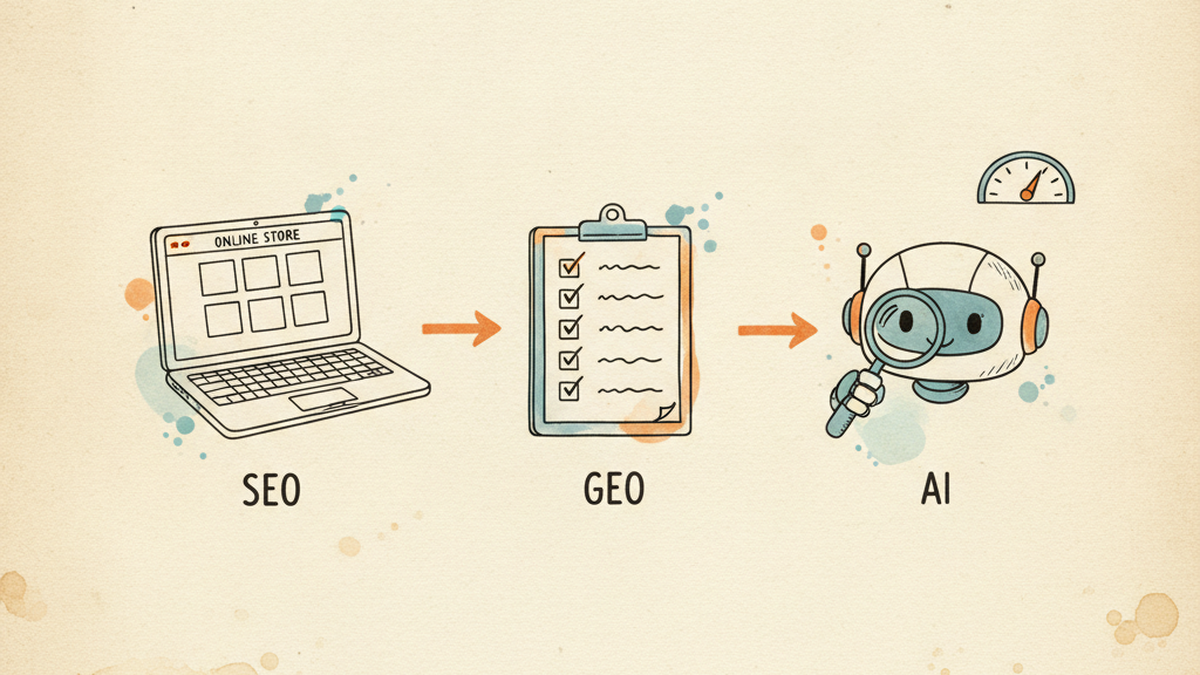
GEO, sometimes written “AI GEO” or “generative engine optimization,” is the practice of making your content easy for AI systems to read, trust, and quote. The shift is the unit of value. Classic SEO competes to rank a whole page. GEO competes to have a specific passage lifted into an answer. Same content foundation, different finish.
| Dimension | Classic SEO | GEO (AI search) |
|---|---|---|
| Goal | Rank the page in Google | Get quoted in an AI answer |
| Unit | The whole page | A single passage or fact |
| Who reads it | Googlebot + a human clicker | AI crawlers + a model summarising |
| Wins on | Relevance, links, speed | Clarity, structure, machine-readable facts |
| Measured by | Rankings, organic clicks | Citations, AI referral traffic |
Keep that overlap in mind as you read. Nothing in the GEO half asks you to undo the SEO half. It asks you to make the same page cleaner for a machine.
The classic Shopify SEO checklist (the foundation that still ranks)
This is the part every guide covers, so I will keep it tight and add what I actually saw break on a real catalog. Do all of it before you touch the GEO layer, because AI systems mostly cite pages that already rank, and none of this works if the fundamentals are missing.
- One keyword-front title per page, under 60 characters. Put the term a buyer types first. On my store the biggest recurring gap was not bad titles, it was no consistent title convention across collections, so I enforce one template store-wide.
- A written meta description. Six of my six deepest-audited collections had none, so Google wrote its own. Write your own for anything with commercial intent.
- One H1, then a logical H2/H3 outline. Structure is not decoration. It is how both Google and an AI model figure out what a page is about.
- Descriptive alt text on every product and hero image. Roughly 40% of my audited collections had no hero image at all, which is a ranking and a trust problem before it is an accessibility one.
- Clean URLs and verified internal links. Every internal link should point to a real, live handle. When I automate this I verify each link against live store inventory so nothing points to a dead collection.
- Collection and product copy with real depth. The pattern I kept finding was bimodal: pages had either zero body copy or a 300-word wall. The band that works is a 40 to 120 word intro above the grid, plus a genuine FAQ below it.
- An XML sitemap, and no-index on thin or duplicate pages. Shopify generates the sitemap; your job is to stop indexing near-duplicate collections that split your own ranking signal.
- Core Web Vitals and theme speed. Trim apps you do not use. Each one adds script weight that a buyer on mobile pays for.
If you want the deeper version of the collection-page work, I wrote a separate walkthrough on optimizing Shopify collection pages. The short version: fix structure, copy, and internal links first, because they are the base every AI system reads from.
The GEO layer nobody’s adding to their Shopify checklist
Most vendor blogs get the next part wrong, and I would rather trust primary sources than hype. The GEO layer is smaller and more boring than the “AI-powered” pitches suggest, and one popular tactic is, per Google, unnecessary. Add these five in order.
1. Structured data, for the right reason
Add schema to your key templates: Product, Collection, FAQ, and Breadcrumb. It makes prices, availability, ratings, and questions machine-readable, which is the whole game for AI. But be precise about why. Google states plainly that for its AI features there is “no special schema.org structured data that you need to add” (Google Search Central, updated December 2025). Schema earns you rich results and clean machine-readable facts. It is not a secret switch that forces an AI to cite you.
On the effort side, this is the highest-leverage item on the page. On my store, every audited collection was missing schema. I fixed all of them with a single JSON-LD template edit in the theme, which pushed the fix across more than 100 collections at once. On my rubric, the Technical and Schema category on a rebuilt collection jumped from 5 out of 15 to 14. One template, one afternoon, catalog-wide.
2. Answer-first copy that a model can lift
Open each important section with a direct 40 to 60 word answer, then expand. AI systems quote self-contained passages, so a section that answers its own heading in the first sentence is far more quotable than one that warms up for three paragraphs. Keep your product and brand names consistent too. Entity clarity, using the same name for the same thing every time, is how a model learns what you are.
Concretely, on a collection page I stopped opening with “Welcome to our collection of premium products” and started with “This collection has 120 gel polish colors, sorted by finish and brand, all in stock and shipping from the US.” The first version says nothing a model can use. The second answers the three questions a buyer and an AI both ask, what is here, how is it organized, and can I get it, in one sentence. That is the whole move, repeated across every page.
3. llms.txt on Shopify: what is real, and what Shopify already did for you
llms.txt is a proposal from Answer.AI (September 2024) for a plain-text file that tells AI tools what your site is about. It is a proposal, not an adopted standard, so treat vendor claims about it with care.
Two things most Shopify checklists get wrong here. First, Google says you do not need it: its 2026 guidance states you do not have to create llms.txt, “AI text files,” or special markup to appear in Search or its AI features (Google Search Central, updated June 2026). Second, if you are on Shopify you likely already have one. Shopify now auto-generates an /agents.md file, and /llms.txt plus /llms-full.txt mirror it unless you add a custom theme template (Shopify, May 2026). Open your-store.myshopify.com/llms.txt right now and you will probably see it.
I checked two stores I run, and they served two different files. The first was Shopify’s default: a short block of agent instructions that points AI shopping assistants at the Universal Commerce Protocol (co-developed by Shopify and Google, endorsed by Wayfair, Target, and Etsy) and tells them how to transact through the Shop skill. No products, just protocol. The second store served a customized version: a one-line store description, a keyword line, then a bulleted list of the main collections with their URLs, plus a “last updated” date. That second file is a plain map of the catalog, the kind of thing an AI can read in one pass to understand what the store sells.
Neither needed hand-coding. So the honest checklist item is not “generate an llms.txt.” It is “open your own /llms.txt, see which of those two you are serving, and write the catalog-map version only if the default does not describe your store well.”
4. Let the right AI crawlers in
GEO fails silently if your robots.txt blocks the bots that feed AI answers. This is the most misunderstood corner of the topic, so here is the cheat-sheet, from each vendor’s own documentation.
| Crawler | Who | What it feeds |
|---|---|---|
| OAI-SearchBot | OpenAI | ChatGPT search results (allow it) |
| GPTBot | OpenAI | Model training (your call) |
| PerplexityBot | Perplexity | Perplexity search, not model training |
| Claude-SearchBot | Anthropic | Claude search relevance |
| Google-Extended | Gemini training only, not Search ranking |
The trap is Google-Extended. Block it and you keep your content out of Gemini training, which is a fair choice, but it does not affect your Google Search ranking at all (Google). Plenty of store owners block it thinking they are protecting rankings. They are not. Default Shopify robots.txt names none of these bots, so they are all allowed. If you want to be in AI search, that default is fine. Just make the choice on purpose.
5. Product pages: schema that matches the shelf
Product pages are the money pages, and they carry a GEO rule the collection pages do not: the Product and Offer schema must mirror the price and availability a shopper actually sees, exactly. Get this wrong and two things break at once. Google Merchant Center can disapprove the item for a price mismatch, and an AI agent reading your structured data can quote a stale price to a buyer, which is worse than not being quoted at all. When I optimize a product page I gate on this: the schema price and stock status have to match the visible ones byte for byte before the page ships.
The other half is the copy. Manufacturer boilerplate is the same text on a thousand other stores, so it gives an AI no reason to cite you specifically. A benefits-first description with a real specs table, a “who it is for” line, and an honest FAQ gives both Google and a model something only your page has. Same discipline as the collection work, applied to the page where the sale happens.
What tools do I use to run this at scale?
Honest answer, cheapest first. Shopify Search & Discovery for faceted filters, which most of my collections were missing. Google Search Console to see which pages already earn impressions, so you optimize the ones with a pulse first. A theme schema edit for the catalog-wide JSON-LD fix above.
And the kit I built, because doing this by hand across hundreds of collections is not realistic. It is an open-source Claude Code project, claude-shopify-growth (MIT licensed), that scores a page on a 100-point rubric covering both SEO and GEO, then rewrites copy, builds the schema bundle, and verifies every internal link against live inventory. It refuses to ship a page that fails any of 18 hard checks: title over 60 characters, hallucinated links, missing schema, and so on.
I am not selling it, it is free, so here is the unglamorous part. Two of those hard checks exist because they broke in production on my own store. An FAQ rendered empty on a live page because the schema was nested the way schema.org examples show, when Shopify’s theme wanted a flat question-and-answer array. Another time deep content saved correctly but never appeared, because the collection used a custom theme template the code did not check for. Both are now gates that stop the run. That is what building on your own store teaches you that a tutorial cannot. The automation behind all of it is Claude talking to Shopify, which I covered in how I connect Claude to my Shopify stores.
Does the GEO layer actually work?
This is the part I have to be honest about, because my voice is not the hype kind. What I can put a file behind is a quality-score lift, not a traffic miracle. On my own 100-point rubric, the collections I started with averaged 48. Three I fully rebuilt using the same collection-page playbook plus the GEO layer scored 95, 96, and 95. The biggest category jumps were exactly the GEO-adjacent ones: Technical and Schema, and SEO intent match.
| Collection (rebuilt) | Rubric before | Rubric after |
|---|---|---|
| Collection A | 55 | 95 |
| Collection B | 52 | 96 |
| Collection C | 52 | 95 |
Composite rubric score, before and after (out of 100)
48
95
96
95
Source: my own collection-analyze rubric (first-party). Baseline is the six-collection audit mean; A, B, and C are three collections I rebuilt with the checklist plus the GEO layer.
What about the AI citations themselves? Those pages now rank on page one and I do see them surfaced in AI answers and recommendations. But I will not hand you a citation-rate number, because I do not have a clean before-and-after measurement of it yet, and a confident wrong number is worse than an honest gap. Treat GEO as compounding, not instant. The score lift is the receipt I can show today; the AI-citation upside is the trend I am still measuring.
Frequently asked questions
What is the difference between SEO and GEO for Shopify?
SEO makes a page rank in Google’s results. GEO makes a page easy for an AI system to read and quote in an answer. They share the same foundation, structured, well-written, crawlable pages, but GEO optimizes for a passage being lifted into an AI response rather than a page ranking on its own.
Do I need an llms.txt file for my Shopify store?
Probably not by hand. Shopify auto-generates an /agents.md file, and /llms.txt mirrors it unless you customize the template. Google also states you do not need llms.txt to appear in its AI features. Check what your store already serves at /llms.txt, then customize only if the default does not describe your catalog well.
How do I get my Shopify pages cited by ChatGPT, Perplexity, or Google AI Overviews?
Rank the page first, since AI answers heavily reuse top-ranking pages. Then make it quotable: answer-first passages, consistent entity names, Product and FAQ schema, and a robots.txt that allows OAI-SearchBot, PerplexityBot, and Claude-SearchBot. There is no paid shortcut and no magic file.
Does schema markup help with AI search?
It helps by making your facts machine-readable and by earning rich results, which support rankings that AI answers draw from. But Google is explicit that no special schema is required for its AI features, so add schema for the real benefits, not because a blog promised it forces citations.
Is the classic SEO checklist still worth doing in 2026?
Yes, and it is still where most of the return is. Roughly 38% of pages cited in Google AI Overviews also rank in the organic top 10, so classic SEO is the on-ramp to AI visibility, not a separate track you can skip.
The verdict: what to do, in order
Do the eight classic items first. They are table stakes and they feed everything else. Then add the GEO layer in this order for the fastest return: schema across your key templates (one theme edit, catalog-wide), answer-first copy on your top pages, a quick look at what Shopify already serves at /llms.txt, and a robots.txt you have chosen on purpose. Skip the paid “GEO tools” that promise citations for a fee, because the two authorities that matter, Google and your own analytics, both say the work is structure and clarity, not a magic file.
If you run more than a handful of collections, the checklist stops being a manual job. That is the gap my open-source kit fills, and it is yours to copy. If you would rather see the paid-side of my operator work, I also wrote up the wasted spend I found auditing my own Google Ads. Same principle either way: run it on a real store, publish the receipts.